

Review: Jesus Christ Superstar in Manila Is a Haunting Modern Rock-Opera Triumph
Jesus Christ Superstar in Manila arrives at Solaire through GMG Productions, bringing the Regent’s Park staging’s rock-opera intensity, visual symbolism, and devastating emotional weight.
LATESTTHEATER REVIEW
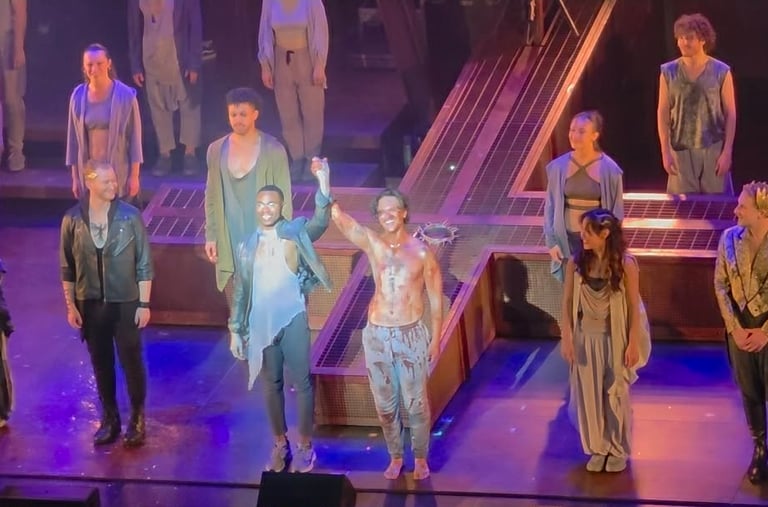
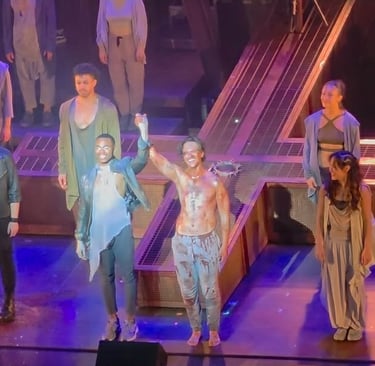
Jesus Christ Superstar has lived many lives since Andrew Lloyd Webber and Tim Rice first introduced it as a rock opera in the 1970s. It has become one of those shows that feels permanently embedded in musical theatre culture, familiar even to people who have never seen it in full. That kind of familiarity can be dangerous. A production can easily lean on the title’s legacy and let the material carry itself. The Regent’s Park Open Air Theatre production, brought to Manila by GMG Productions and now playing at The Theatre at Solaire following its May 2 opening, does the opposite. Directed by Timothy Sheader, with choreography by Drew McOnie and design by Tom Scutt, this staging feels urgent, muscular, and deeply awake to the world of the show. At the May 3 evening performance I saw, Joshua Bess performed as Jesus, with Javon King as Judas, Gab Pangilinan as Mary, Ethan Hardy Benson as Pilate, Grant Hodges as Caiaphas, and Kodiak Thompson as Annas.
What makes this production feel so refreshing is how completely it commits to the language of a rock opera. The handheld microphones, exposed band energy, electric guitars, scaffolding, hard lighting, and almost concert-like urgency do not feel imposed on the material. They feel native to it. The stage is bare enough to make every body, sound, and gesture matter. The performers sing like rock vocalists, but the staging never loses its theatrical precision. Everything feels stripped, exposed, raw, and honest, which suits a musical built on belief, betrayal, performance, and public collapse.
For me, one of the central themes of Jesus Christ Superstar is fame and mass worship. Viewed through a modern lens, this production becomes a commentary on idol culture and our obsession with public figures. The crowd does not always fully understand Jesus’ message, yet they follow him with intense devotion because the figure himself begins to mean more to them than what he stands for. The show reflects the way celebrity culture can turn admiration into spectacle, where people worship an image without fully engaging with the meaning behind it. What makes it more unsettling is how quickly that worship curdles. The same crowd that celebrates Jesus later turns against him, and in this staging, that shift feels strikingly modern. It mirrors a culture where people elevate someone into an icon, misunderstand what they represent, and discard them once the fantasy breaks. Mass worship becomes unstable because it is often built more on projection than true understanding.
That idea runs through the production’s physical language. Jesus is presented as a public figure surrounded by followers, pressure, and attention. The atmosphere comes from bodies, music, lighting, and movement more than literal scenery. The ensemble does not feel like background. They feel like a force. They watch, swarm, reach, demand, and accuse. Their presence makes devotion feel overwhelming, and later, dangerous. I felt how easy it was for worship to become consumption, and how easily consumption could become violence.
One of the strongest and most divisive choices in the show is the way it gives its characters fuller motivations and moral weight. Judas’ betrayal is at the very center of the musical, but the production does not flatten it into a simple act of greed. It presents betrayal as something more complicated, something wrapped in fear, frustration, conviction, and the terrible arrogance of thinking one can control the consequences of a choice. The show never asks the audience to excuse Judas. It does, however, make his internal conflict impossible to dismiss.
Javon King is the production’s standout as Judas. His vocal prowess and command of the stage make you feel the gravity of every word he sings. He moves through the role with the urgency of someone who believes he is seeing clearly while everyone around him has been blinded by devotion. What makes his performance so compelling is that he does not play Judas as a villain waiting to betray. He plays him as a man already trapped by his own reasoning. More than once, I felt pulled dangerously close to understanding his side, which is exactly the tension the performance needs. King makes Judas’ fear, frustration, and conviction feel alive in the body, not just in the lyrics.
The show also humanizes Jesus by emphasizing his fear, loneliness, exhaustion, and conflict. Joshua Bess gives a performance that carries that emotional strain with real force. His Jesus is not distant or untouchable. He is surrounded by worship, yet often seems profoundly alone inside it. That contradiction gives the production much of its heaviness. Bess makes the role feel like a person carrying a burden that everyone claims to understand, but almost no one truly sees.
Gab Pangilinan’s casting as Mary makes immediate sense. Her softness stands out against the production’s chaotic backdrop, giving the show a necessary emotional stillness. Alongside Bess as Jesus, she delivers a performance that feels tender and grounded. Their chemistry is natural and believable, and their scenes together offer some of the production’s most intimate moments. With Mary beside him, Jesus feels less untouchable and more like a person going through a lot, carrying an unbearable weight. In a production full of noise, pressure, and spectacle, Mary becomes one of the few presences that allows Jesus to be seen as a person rather than an idea.
What makes this staging work so well is how fully it understands the language of a rock opera. At first, the microphones feel natural to the form. They belong to the concert-like vocabulary of the production. But as the story unfolds, these objects begin to carry more meaning. A microphone starts as something functional, then later becomes charged with symbolism and visual metaphor that amplifies the emotional weight of the scene.
That visual language is already present in the production’s artwork, which shows a man carrying a microphone, his hands covered in sparkly silver paint. Coming into the show, I assumed it was connected to the “Superstar” aspect of the brand, making Jesus look like a pop star or stage icon. That reading felt even more convincing through the artwork’s use of confetti and concert imagery. But by the end of Act One, I realized I had been looking at it too simply. The man in that image is not Jesus. It is Judas. The reveal lands with such artful force because the production has been preparing the image all along without spelling it out.
When Judas is bribed to provide information about Jesus’ whereabouts, he is presented with a wooden chest. Because I know the biblical story, I understood immediately that it refers to the thirty pieces of silver. But true to the nature of this staging, the production does not show it literally. The chest opens to reveal liquid silver, and Judas dips his hands into it. It marks him for the rest of the show, as if his guilt has become visible on his body. The payment becomes a form of contamination, a sealing of fate. As the curtain closed on Act One, I remember realizing that I had just seen one of the most impactful act endings I have experienced in theatre. It was both poetic and devastating.
The microphone returns as another example of the production’s incredible use of metaphor and symbolism. Judas’ microphone begins as an instrument for expressing his thoughts, then gradually becomes an image of his demise. The wire seems to carry more weight the deeper he falls into the consequences of his choice. It feels as though it becomes longer and more inescapable as he loses control over what follows his decision to accept the bribe. The production does not need to show his suicide literally. Instead, it uses the microphone in a way that suggests it, through the visual language of a mic drop transformed into something final. There is a particular pleasure in theatre that trusts its audience to make these connections, allowing meaning to unfold like poetry.
The use of glitter during the thirty-nine lashes was another extraordinary choice. On paper, glitter suggests celebration, glamour, and spectacle. Here, it becomes pain. It becomes the whip. It becomes the crowd’s excitement and Jesus’ suffering existing in the same image. That contradiction is what makes it so heartbreaking. The glitter can read as celebration because by this point, the people have started turning their backs on Jesus and almost consuming the moment of his torture. It also reads as pain, because it stands in for the violence being inflicted on him, the anguish of those who still care for him, and the physical torment Jesus endures. The production makes suffering beautiful to look at, then forces you to confront the discomfort of finding beauty in it.
These examples are only three of the many ways the production uses creative liberty to tell the story. What I admire is that the symbolism never feels decorative. It deepens the staging’s larger argument about spectacle, worship, guilt, and public violence. The show understands that in a world obsessed with performance, even suffering can become something staged, watched, and consumed. That is what makes the production feel so coherent. Its visual choices are not separate from its themes. They are the themes.
The ending is heavy in a way I did not expect, even though I knew where the story was going. The show ends with Jesus dying. There is no resurrection, no cathartic turn toward triumph, no release from the brutality of what has happened. For a brief moment, I felt myself resisting it. I remember thinking that this could not be the ending. Then it hit me that it was. No spectacle. No resurrection. Just a man the crowd used to celebrate, now presented in front of us wounded and dead. That final image stayed with me because it refuses comfort. It leaves the audience with the cost of worship, the violence of public rejection, and the silence after everything has been spent.
By the end, I felt the audience around me had been effectively moved by it. I was moved by it. I felt the heaviness of the show in my body. That, to me, is one of the great gifts of live theatre. It can take a story you already know and still make you experience it as if the ending has just arrived in front of you for the first time.
I give this production a much-deserved 10/10. It is brilliantly executed, vocally thrilling, visually intelligent, and emotionally punishing in the best way. Its few risks are exactly what make it work. It does not try to pass itself off as doctrine. After all, it is a musical, not a sacred text. When viewed through that lens, this Jesus Christ Superstar truly shines. It understands the rock opera as performance, prayer, protest, spectacle, and tragedy all at once. More importantly, it trusts the audience to feel the connections rather than be handed every answer.
I left The Theatre at Solaire reminded of why I love live performance so deeply. Theatre can be loud, glittering, and amplified, but its most powerful moments often come from recognition. A silver-stained hand. A microphone wire. A crowd changing its mind. A body left in silence. In this production, those images speak with more force than explanation ever could.
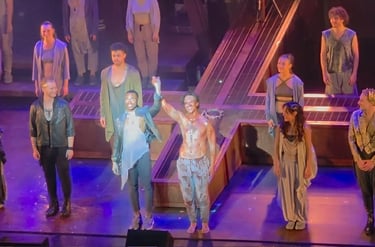
Jesus Christ Superstar has lived many lives since Andrew Lloyd Webber and Tim Rice first introduced it as a rock opera in the 1970s. It has become one of those shows that feels permanently embedded in musical theatre culture, familiar even to people who have never seen it in full. That kind of familiarity can be dangerous. A production can easily lean on the title’s legacy and let the material carry itself. The Regent’s Park Open Air Theatre production, brought to Manila by GMG Productions and now playing at The Theatre at Solaire following its May 2 opening, does the opposite. Directed by Timothy Sheader, with choreography by Drew McOnie and design by Tom Scutt, this staging feels urgent, muscular, and deeply awake to the world of the show. At the May 3 evening performance I saw, Joshua Bess performed as Jesus, with Javon King as Judas, Gab Pangilinan as Mary, Ethan Hardy Benson as Pilate, Grant Hodges as Caiaphas, and Kodiak Thompson as Annas.
What makes this production feel so refreshing is how completely it commits to the language of a rock opera. The handheld microphones, exposed band energy, electric guitars, scaffolding, hard lighting, and almost concert-like urgency do not feel imposed on the material. They feel native to it. The stage is bare enough to make every body, sound, and gesture matter. The performers sing like rock vocalists, but the staging never loses its theatrical precision. Everything feels stripped, exposed, raw, and honest, which suits a musical built on belief, betrayal, performance, and public collapse.
For me, one of the central themes of Jesus Christ Superstar is fame and mass worship. Viewed through a modern lens, this production becomes a commentary on idol culture and our obsession with public figures. The crowd does not always fully understand Jesus’ message, yet they follow him with intense devotion because the figure himself begins to mean more to them than what he stands for. The show reflects the way celebrity culture can turn admiration into spectacle, where people worship an image without fully engaging with the meaning behind it. What makes it more unsettling is how quickly that worship curdles. The same crowd that celebrates Jesus later turns against him, and in this staging, that shift feels strikingly modern. It mirrors a culture where people elevate someone into an icon, misunderstand what they represent, and discard them once the fantasy breaks. Mass worship becomes unstable because it is often built more on projection than true understanding.
That idea runs through the production’s physical language. Jesus is presented as a public figure surrounded by followers, pressure, and attention. The atmosphere comes from bodies, music, lighting, and movement more than literal scenery. The ensemble does not feel like background. They feel like a force. They watch, swarm, reach, demand, and accuse. Their presence makes devotion feel overwhelming, and later, dangerous. I felt how easy it was for worship to become consumption, and how easily consumption could become violence.
One of the strongest and most divisive choices in the show is the way it gives its characters fuller motivations and moral weight. Judas’ betrayal is at the very center of the musical, but the production does not flatten it into a simple act of greed. It presents betrayal as something more complicated, something wrapped in fear, frustration, conviction, and the terrible arrogance of thinking one can control the consequences of a choice. The show never asks the audience to excuse Judas. It does, however, make his internal conflict impossible to dismiss.
Javon King is the production’s standout as Judas. His vocal prowess and command of the stage make you feel the gravity of every word he sings. He moves through the role with the urgency of someone who believes he is seeing clearly while everyone around him has been blinded by devotion. What makes his performance so compelling is that he does not play Judas as a villain waiting to betray. He plays him as a man already trapped by his own reasoning. More than once, I felt pulled dangerously close to understanding his side, which is exactly the tension the performance needs. King makes Judas’ fear, frustration, and conviction feel alive in the body, not just in the lyrics.
The show also humanizes Jesus by emphasizing his fear, loneliness, exhaustion, and conflict. Joshua Bess gives a performance that carries that emotional strain with real force. His Jesus is not distant or untouchable. He is surrounded by worship, yet often seems profoundly alone inside it. That contradiction gives the production much of its heaviness. Bess makes the role feel like a person carrying a burden that everyone claims to understand, but almost no one truly sees.
Gab Pangilinan’s casting as Mary makes immediate sense. Her softness stands out against the production’s chaotic backdrop, giving the show a necessary emotional stillness. Alongside Bess as Jesus, she delivers a performance that feels tender and grounded. Their chemistry is natural and believable, and their scenes together offer some of the production’s most intimate moments. With Mary beside him, Jesus feels less untouchable and more like a person going through a lot, carrying an unbearable weight. In a production full of noise, pressure, and spectacle, Mary becomes one of the few presences that allows Jesus to be seen as a person rather than an idea.
What makes this staging work so well is how fully it understands the language of a rock opera. At first, the microphones feel natural to the form. They belong to the concert-like vocabulary of the production. But as the story unfolds, these objects begin to carry more meaning. A microphone starts as something functional, then later becomes charged with symbolism and visual metaphor that amplifies the emotional weight of the scene.
That visual language is already present in the production’s artwork, which shows a man carrying a microphone, his hands covered in sparkly silver paint. Coming into the show, I assumed it was connected to the “Superstar” aspect of the brand, making Jesus look like a pop star or stage icon. That reading felt even more convincing through the artwork’s use of confetti and concert imagery. But by the end of Act One, I realized I had been looking at it too simply. The man in that image is not Jesus. It is Judas. The reveal lands with such artful force because the production has been preparing the image all along without spelling it out.
When Judas is bribed to provide information about Jesus’ whereabouts, he is presented with a wooden chest. Because I know the biblical story, I understood immediately that it refers to the thirty pieces of silver. But true to the nature of this staging, the production does not show it literally. The chest opens to reveal liquid silver, and Judas dips his hands into it. It marks him for the rest of the show, as if his guilt has become visible on his body. The payment becomes a form of contamination, a sealing of fate. As the curtain closed on Act One, I remember realizing that I had just seen one of the most impactful act endings I have experienced in theatre. It was both poetic and devastating.
The microphone returns as another example of the production’s incredible use of metaphor and symbolism. Judas’ microphone begins as an instrument for expressing his thoughts, then gradually becomes an image of his demise. The wire seems to carry more weight the deeper he falls into the consequences of his choice. It feels as though it becomes longer and more inescapable as he loses control over what follows his decision to accept the bribe. The production does not need to show his suicide literally. Instead, it uses the microphone in a way that suggests it, through the visual language of a mic drop transformed into something final. There is a particular pleasure in theatre that trusts its audience to make these connections, allowing meaning to unfold like poetry.
The use of glitter during the thirty-nine lashes was another extraordinary choice. On paper, glitter suggests celebration, glamour, and spectacle. Here, it becomes pain. It becomes the whip. It becomes the crowd’s excitement and Jesus’ suffering existing in the same image. That contradiction is what makes it so heartbreaking. The glitter can read as celebration because by this point, the people have started turning their backs on Jesus and almost consuming the moment of his torture. It also reads as pain, because it stands in for the violence being inflicted on him, the anguish of those who still care for him, and the physical torment Jesus endures. The production makes suffering beautiful to look at, then forces you to confront the discomfort of finding beauty in it.
These examples are only three of the many ways the production uses creative liberty to tell the story. What I admire is that the symbolism never feels decorative. It deepens the staging’s larger argument about spectacle, worship, guilt, and public violence. The show understands that in a world obsessed with performance, even suffering can become something staged, watched, and consumed. That is what makes the production feel so coherent. Its visual choices are not separate from its themes. They are the themes.
The ending is heavy in a way I did not expect, even though I knew where the story was going. The show ends with Jesus dying. There is no resurrection, no cathartic turn toward triumph, no release from the brutality of what has happened. For a brief moment, I felt myself resisting it. I remember thinking that this could not be the ending. Then it hit me that it was. No spectacle. No resurrection. Just a man the crowd used to celebrate, now presented in front of us wounded and dead. That final image stayed with me because it refuses comfort. It leaves the audience with the cost of worship, the violence of public rejection, and the silence after everything has been spent.
By the end, I felt the audience around me had been effectively moved by it. I was moved by it. I felt the heaviness of the show in my body. That, to me, is one of the great gifts of live theatre. It can take a story you already know and still make you experience it as if the ending has just arrived in front of you for the first time.
I give this production a much-deserved 10/10. It is brilliantly executed, vocally thrilling, visually intelligent, and emotionally punishing in the best way. Its few risks are exactly what make it work. It does not try to pass itself off as doctrine. After all, it is a musical, not a sacred text. When viewed through that lens, this Jesus Christ Superstar truly shines. It understands the rock opera as performance, prayer, protest, spectacle, and tragedy all at once. More importantly, it trusts the audience to feel the connections rather than be handed every answer.
I left The Theatre at Solaire reminded of why I love live performance so deeply. Theatre can be loud, glittering, and amplified, but its most powerful moments often come from recognition. A silver-stained hand. A microphone wire. A crowd changing its mind. A body left in silence. In this production, those images speak with more force than explanation ever could.
Related Articles
Related Articles

Stay in the Loop
Get fresh reviews and theatre news straight from your inbox.
Editorial & Press Inquiries
Looking to feature your production or extend a press invitation? I’d love to hear from you.
whilitshow@gmail.com
Editorial & Press Inquiries
Looking to feature your production or extend a press invitation? I’d love to hear from you.
whilitshow@gmail.com
Contact
Follow me on social media
whilitshow@gmail.com
© 2026. All rights reserved.