

Review: Miss Saigon in Singapore – A Landmark Musical at a Turning Point
As Miss Saigon plays its final Singapore performance, the production highlights both the musical’s emotional force and the debates that continue to surround it.
THEATER REVIEWLATEST
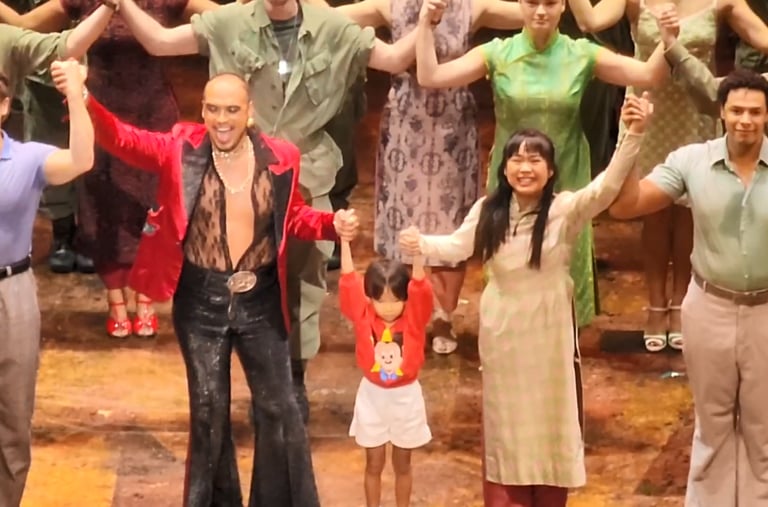
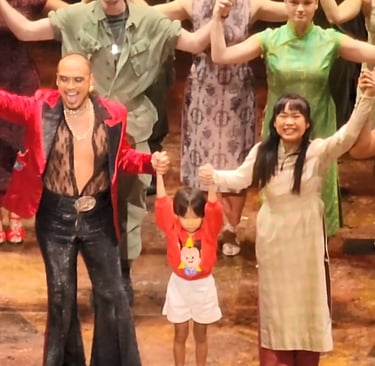
By the final night of Miss Saigon’s Singapore run at the Sands Theatre, Marina Bay Sands, the musical carried more than the weight of its story. This Australian production arrived at a moment when Miss Saigon’s legacy feels both firmly established and increasingly contested. Long celebrated as a global theatrical phenomenon, the show has also become a touchstone for ongoing conversations about representation, power, and narrative framing. Reports that this Singapore engagement may mark Cameron Mackintosh’s last major large-scale production of the musical lent the performance an added sense of finality. Having missed its Manila run due to work, traveling to Singapore for the closing night felt necessary. This was not simply about revisiting a familiar title, but about witnessing the end of an era, complicated though that era may be.
Few musicals carry a legacy as layered as Miss Saigon. When it premiered in London in 1989 before transferring to Broadway in 1991, it quickly became a global phenomenon. Inspired loosely by Madama Butterfly, the show tapped into spectacle, romance, and tragedy in ways that proved enormously popular. It also introduced the world to Lea Salonga, whose performance as Kim earned her both the Tony and Olivier Awards, a historic achievement that reshaped what Asian representation in Western musical theatre could look like. From that point on, Miss Saigon became not just a hit, but a launching pad. Many of its leading performers went on to international careers, and the role of Kim in particular became a benchmark for vocal and emotional endurance.
The show’s revival history only reinforced that legacy. The Broadway revival starring Eva Noblezada brought renewed attention to the material and further cemented Miss Saigon as a career-defining production for its leads. Time and again, the musical has functioned as both opportunity and proving ground.
But its endurance has never existed without friction. From its earliest days, Miss Saigon has been surrounded by controversy, much of it unresolved. Criticism has focused on its portrayal of Vietnam, its framing of Asian women through Western gaze, and its reliance on a white savior narrative that centers American moral reckoning over Vietnamese agency. Those conversations have not faded with time. If anything, they have grown louder and more precise. The fact that Miss Saigon continues to be produced globally only ensures that these questions remain active, and they should.
That context matters, especially when watching the show now, in 2024, at the very end of its run in Singapore.
This Australian production, which played from August 15 to September 29, arrived polished, muscular, and technically assured. The scale was unmistakable. The helicopter sequence, the crowd scenes, the orchestration, and the relentless pacing all reminded me why Miss Saigon became such a dominant force in musical theatre history. It is designed to overwhelm, and it still does.
At the center of the final performance was Abigail Adriano as Kim, and her work stayed with me long after the curtain call. This is an extraordinarily demanding role, emotionally and physically, and Adriano carried it with focus and commitment. What struck me most was how contemporary her Kim felt. There was a subtle shift in her interpretation, one that read as distinctly of this moment in its emotional clarity and self-awareness. In a few key moments, she allowed Kim brief flashes of agency that felt intentional, even if necessarily limited by the text. It was not a reinvention of the character, but it offered a slightly altered perspective on her inner life.
This is not an easy role to perform under ideal circumstances, and Adriano was reportedly recovering from a cold during this performance. If there were limitations, they did not register emotionally. Her voice remained clear and controlled, often angelic in its softness, and she committed fully to the material. The emotional labor required of Kim is immense, and Adriano never appeared to ration her energy. Watching her, I felt confident that she is only at the beginning of a significant career. (Since writing this review, she has announced on social media that she has been cast as Eurydice in the Australian production of Hadestown.)
If Adriano’s Kim stayed largely faithful to the original material while finding moments of modern texture, Seann Miley Moore’s Engineer moved decisively in another direction. Moore’s interpretation was unapologetically contemporary, often referred to as “The Engiqueer,” and it worked on its own terms. This was not an attempt to soften or redeem the character. Moore played the Engineer as cruel, strategic, and deeply self-interested, but layered that cruelty with personal specificity. His costumes were designed to catch the light, his presence radiated through the theatre, and his energy traveled all the way to the back of the balcony.
What made Moore’s performance compelling was not novelty, but confidence. He did not play the role in opposition to its history, nor did he attempt to replicate it. He brought himself into it, expanding the character’s dimensions rather than narrowing them. The result was an Engineer who felt dangerous, theatrical, and disturbingly plausible.
Nigel Huckle as Chris grounded the production emotionally. His Chris was haunted, conflicted, and vocally assured. The chemistry between Huckle and Adriano was evident, and knowing the trajectory of their relationship only heightened the tension in their shared scenes. “Sun and Moon” landed with intimacy, but it was “Last Night of the World” that became the emotional centerpiece for me. In that moment, Adriano’s Kim felt young, hopeful, and heartbreakingly sincere, clinging to a future that the audience already knows will not arrive.
Kiara Dario’s Gigi made a strong impression despite limited stage time. Her performance captured desperation without exaggeration. Where the Engineer operates with calculation, Gigi’s longing felt unstructured and fragile. Her dream of America did not read as ambition so much as escape, and watching that hope collapse was quietly devastating. Dario used her time efficiently, telling a complete story in a short span.
The supporting cast strengthened the production further. Laurence Mossman as Thuy brought menace and rigidity without flattening the character, while Lewis Francis as John offered steadiness and moral tension. Sarah Morrison’s Ellen handled one of the show’s most difficult roles with clarity and restraint. While the audience’s emotional allegiance naturally lies with Kim, Morrison made it clear that Ellen is not an antagonist, but another person caught in the aftermath of decisions made long before her arrival. That clarity gave the role weight and credibility. Across the board, the casting choices felt justified and well-considered.
The moment that lingered most, however, came at the end. As Kim’s final decision unfolded, I heard audible reactions from the balcony around me. Disappointment. A collective “oh…” voiced mostly by women who, judging by their responses, had not known how the story would end. In today’s cultural moment, where empowerment is not just desired but expected, the ending landed hard and divisively. It felt out of step with the instincts of a modern audience trained to root for survival, autonomy, and escape.
I understand that reaction. Kim’s choice is deeply polarizing, and it always has been. From the outside, it is easy to imagine alternatives. To want something different for her. But that impulse exists precisely because we are not inside her circumstances or her mind. The show does not ask us to agree with her decision so much as to confront the limits placed on her world. That tension remains uncomfortable, and it should.
Watching Miss Saigon on its final night in Singapore made its contradictions impossible to ignore, but also impossible to dismiss. This is a musical whose scale, craft, and emotional force are undeniable, even as its worldview remains contested. The conversations surrounding its politics, its framing of Vietnam, and its treatment of its central heroine are not distractions from the work, but part of its ongoing life. Hearing audience reactions in the balcony during the final moments underscored how much those questions still resonate. The discomfort did not feel like rejection, but reckoning. For better or worse, Miss Saigon continues to demand engagement rather than passive acceptance, and seeing it at this moment, at this scale, made that tension feel especially present.
I am giving Miss Saigon in Singapore an 8.5 out of 10. It is a strong, accomplished production of a musical that remains technically impressive and emotionally demanding. I am grateful to have seen it, especially knowing this may be the last time it appears on this scale. Whatever one’s feelings about its politics or its ending, Miss Saigon continues to provoke conversation, and watching it on its final night only underscored how complicated, and how consequential, its legacy remains.
By the final night of Miss Saigon’s Singapore run at the Sands Theatre, Marina Bay Sands, the musical carried more than the weight of its story. This Australian production arrived at a moment when Miss Saigon’s legacy feels both firmly established and increasingly contested. Long celebrated as a global theatrical phenomenon, the show has also become a touchstone for ongoing conversations about representation, power, and narrative framing. Reports that this Singapore engagement may mark Cameron Mackintosh’s last major large-scale production of the musical lent the performance an added sense of finality. Having missed its Manila run due to work, traveling to Singapore for the closing night felt necessary. This was not simply about revisiting a familiar title, but about witnessing the end of an era, complicated though that era may be.
Few musicals carry a legacy as layered as Miss Saigon. When it premiered in London in 1989 before transferring to Broadway in 1991, it quickly became a global phenomenon. Inspired loosely by Madama Butterfly, the show tapped into spectacle, romance, and tragedy in ways that proved enormously popular. It also introduced the world to Lea Salonga, whose performance as Kim earned her both the Tony and Olivier Awards, a historic achievement that reshaped what Asian representation in Western musical theatre could look like. From that point on, Miss Saigon became not just a hit, but a launching pad. Many of its leading performers went on to international careers, and the role of Kim in particular became a benchmark for vocal and emotional endurance.
The show’s revival history only reinforced that legacy. The Broadway revival starring Eva Noblezada brought renewed attention to the material and further cemented Miss Saigon as a career-defining production for its leads. Time and again, the musical has functioned as both opportunity and proving ground.
But its endurance has never existed without friction. From its earliest days, Miss Saigon has been surrounded by controversy, much of it unresolved. Criticism has focused on its portrayal of Vietnam, its framing of Asian women through Western gaze, and its reliance on a white savior narrative that centers American moral reckoning over Vietnamese agency. Those conversations have not faded with time. If anything, they have grown louder and more precise. The fact that Miss Saigon continues to be produced globally only ensures that these questions remain active, and they should.
That context matters, especially when watching the show now, in 2024, at the very end of its run in Singapore.
This Australian production, which played from August 15 to September 29, arrived polished, muscular, and technically assured. The scale was unmistakable. The helicopter sequence, the crowd scenes, the orchestration, and the relentless pacing all reminded me why Miss Saigon became such a dominant force in musical theatre history. It is designed to overwhelm, and it still does.
At the center of the final performance was Abigail Adriano as Kim, and her work stayed with me long after the curtain call. This is an extraordinarily demanding role, emotionally and physically, and Adriano carried it with focus and commitment. What struck me most was how contemporary her Kim felt. There was a subtle shift in her interpretation, one that read as distinctly of this moment in its emotional clarity and self-awareness. In a few key moments, she allowed Kim brief flashes of agency that felt intentional, even if necessarily limited by the text. It was not a reinvention of the character, but it offered a slightly altered perspective on her inner life.
This is not an easy role to perform under ideal circumstances, and Adriano was reportedly recovering from a cold during this performance. If there were limitations, they did not register emotionally. Her voice remained clear and controlled, often angelic in its softness, and she committed fully to the material. The emotional labor required of Kim is immense, and Adriano never appeared to ration her energy. Watching her, I felt confident that she is only at the beginning of a significant career. (Since writing this review, she has announced on social media that she has been cast as Eurydice in the Australian production of Hadestown.)
If Adriano’s Kim stayed largely faithful to the original material while finding moments of modern texture, Seann Miley Moore’s Engineer moved decisively in another direction. Moore’s interpretation was unapologetically contemporary, often referred to as “The Engiqueer,” and it worked on its own terms. This was not an attempt to soften or redeem the character. Moore played the Engineer as cruel, strategic, and deeply self-interested, but layered that cruelty with personal specificity. His costumes were designed to catch the light, his presence radiated through the theatre, and his energy traveled all the way to the back of the balcony.
What made Moore’s performance compelling was not novelty, but confidence. He did not play the role in opposition to its history, nor did he attempt to replicate it. He brought himself into it, expanding the character’s dimensions rather than narrowing them. The result was an Engineer who felt dangerous, theatrical, and disturbingly plausible.
Nigel Huckle as Chris grounded the production emotionally. His Chris was haunted, conflicted, and vocally assured. The chemistry between Huckle and Adriano was evident, and knowing the trajectory of their relationship only heightened the tension in their shared scenes. “Sun and Moon” landed with intimacy, but it was “Last Night of the World” that became the emotional centerpiece for me. In that moment, Adriano’s Kim felt young, hopeful, and heartbreakingly sincere, clinging to a future that the audience already knows will not arrive.
Kiara Dario’s Gigi made a strong impression despite limited stage time. Her performance captured desperation without exaggeration. Where the Engineer operates with calculation, Gigi’s longing felt unstructured and fragile. Her dream of America did not read as ambition so much as escape, and watching that hope collapse was quietly devastating. Dario used her time efficiently, telling a complete story in a short span.
The supporting cast strengthened the production further. Laurence Mossman as Thuy brought menace and rigidity without flattening the character, while Lewis Francis as John offered steadiness and moral tension. Sarah Morrison’s Ellen handled one of the show’s most difficult roles with clarity and restraint. While the audience’s emotional allegiance naturally lies with Kim, Morrison made it clear that Ellen is not an antagonist, but another person caught in the aftermath of decisions made long before her arrival. That clarity gave the role weight and credibility. Across the board, the casting choices felt justified and well-considered.
The moment that lingered most, however, came at the end. As Kim’s final decision unfolded, I heard audible reactions from the balcony around me. Disappointment. A collective “oh…” voiced mostly by women who, judging by their responses, had not known how the story would end. In today’s cultural moment, where empowerment is not just desired but expected, the ending landed hard and divisively. It felt out of step with the instincts of a modern audience trained to root for survival, autonomy, and escape.
I understand that reaction. Kim’s choice is deeply polarizing, and it always has been. From the outside, it is easy to imagine alternatives. To want something different for her. But that impulse exists precisely because we are not inside her circumstances or her mind. The show does not ask us to agree with her decision so much as to confront the limits placed on her world. That tension remains uncomfortable, and it should.
Watching Miss Saigon on its final night in Singapore made its contradictions impossible to ignore, but also impossible to dismiss. This is a musical whose scale, craft, and emotional force are undeniable, even as its worldview remains contested. The conversations surrounding its politics, its framing of Vietnam, and its treatment of its central heroine are not distractions from the work, but part of its ongoing life. Hearing audience reactions in the balcony during the final moments underscored how much those questions still resonate. The discomfort did not feel like rejection, but reckoning. For better or worse, Miss Saigon continues to demand engagement rather than passive acceptance, and seeing it at this moment, at this scale, made that tension feel especially present.
I am giving Miss Saigon in Singapore an 8.5 out of 10. It is a strong, accomplished production of a musical that remains technically impressive and emotionally demanding. I am grateful to have seen it, especially knowing this may be the last time it appears on this scale. Whatever one’s feelings about its politics or its ending, Miss Saigon continues to provoke conversation, and watching it on its final night only underscored how complicated, and how consequential, its legacy remains.
Related Articles
Related Articles

Stay in the Loop
Get fresh reviews and theatre news straight from your inbox.
Editorial & Press Inquiries
Looking to feature your production or extend a press invitation? I’d love to hear from you.
whilgorumba@gmail.com
Editorial & Press Inquiries
Looking to feature your production or extend a press invitation? I’d love to hear from you.
whilgorumba@gmail.com
Contact
Follow me on social media
whilitshow@gmail.com
© 2026. All rights reserved.