
Review: Wicked in Singapore – A Classic That Keeps Finding New Audiences
With a strong cast and assured staging, Wicked in Singapore underscores the musical’s appeal and thematic relevance as it finds renewed attention among wider audiences.
THEATER REVIEWLATEST
By the time Wicked arrived in Singapore for its limited engagement at the Sands Theatre, Marina Bay Sands, the musical occupied a very particular place in public consciousness. It was no longer just a long-running Broadway institution or a rite of passage for theatre fans. With the release of the first Wicked film adaptation starring Ariana Grande and Cynthia Erivo, Oz had reentered the mainstream in a new way. Curiosity around the story had expanded beyond traditional theatre audiences, drawing in moviegoers, casual fans, and first-timers eager to see where it all began.
That renewed attention only adds weight to a stage production like this one. Wicked opened on Broadway in October 2003, and by March 2025, it had firmly secured its place as the fourth longest-running show in Broadway history. Its endurance is not accidental. Adapted from Gregory Maguire’s novel, which itself reimagines the world of The Wizard of Oz through a political and moral lens, the musical has always balanced spectacle with an unusually pointed set of ideas. Questions of power, propaganda, social conformity, and moral labeling sit beneath its glossy exterior. With the film now amplifying its reach, the stage production has more to live up to than ever.
The Australian production of Wicked, which played in Singapore from March 19 to April 27, 2025, arrived carrying that legacy confidently. I attended the March 28 performance, having traveled from Manila with this show as my sole itinerary. Expectations were high, and not just because of the musical’s reputation. This production had the task of satisfying longtime fans deeply familiar with the stage version while welcoming a new audience whose first exposure may have been cinematic.
It succeeded on both fronts.
Visually, the production delivered exactly what audiences expect from Wicked. The scale is impressive without feeling excessive, and after more than two decades, the show still understands how to deploy spectacle strategically. Set pieces move with purpose, lighting is used to guide attention rather than overwhelm it, and the visual language remains clear even at its most elaborate. The technology serves the storytelling, not the other way around, which is perhaps why the show continues to age well.
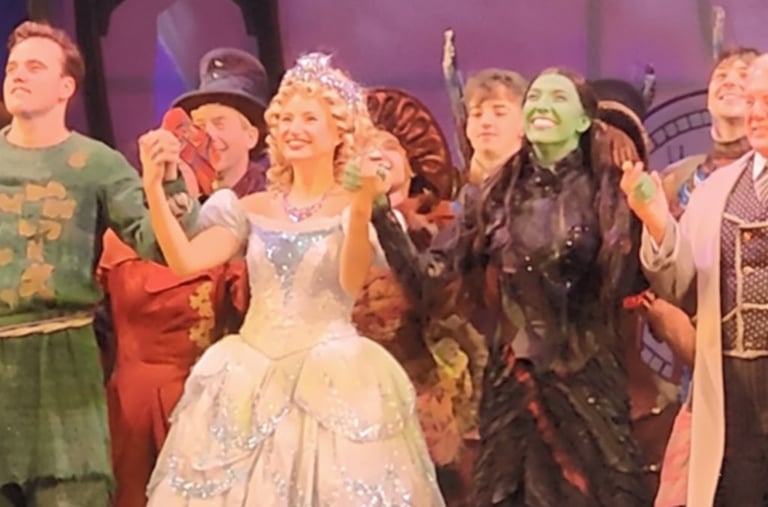
At the center of this production were Courtney Monsma as Glinda and Zoe Coppinger as Elphaba, whose partnership carried the show with precision and contrast. Monsma’s Glinda leaned unapologetically into cartoonishness, as the role demands. Her physicality, vocal inflections, and comedic timing were heightened to the point of exaggeration, and that choice worked. Glinda, after all, is written as a performance of goodness, and Monsma treated that performance as something deliberately artificial. What impressed me was how sharply she shifted gears when the material required seriousness. In moments of consequence, the cartoon fell away. Her Glinda became focused, restrained, and emotionally legible, revealing the cost of maintaining charm as a form of self-preservation.
That complexity is not easy to sustain, especially in a role performed multiple times a week, sometimes twice a day. Monsma handled it with confidence and consistency. Having been familiar with her work prior to this production, I still found myself surprised by the authority she brought to the role live.
Zoe Coppinger matched that duality from the opposite direction. As Elphaba, she allowed herself moments of humor, particularly in scenes shared with Glinda, where her timing and reactions grounded their friendship in something recognizably human. But when the story demanded conviction, Coppinger expanded into it fully. Her Elphaba was driven by principle and moral clarity, and she articulated the character’s urgency with focus and control. She framed Elphaba’s defiance as a conscious choice rather than a reaction, giving weight to the character’s cause as the narrative progressed. Vocally, she was assured and expressive. During “The Wizard and I,” I found myself briefly closing my eyes, not out of disengagement, but to focus on the quality of her voice and phrasing. It was a moment of clarity in a show filled with movement and information.
Together, their performances created a dynamic that felt both playful and ideologically charged. The contrast between Glinda’s performative optimism and Elphaba’s principled resistance was clear, and the show was strongest when that contrast was allowed to sharpen rather than blur.
The show’s most iconic moment, “Defying Gravity,” remains effective, even after years of cultural saturation. Coppinger’s ascent was well-executed, and the staging created a convincing illusion of flight. It is a moment that risks losing impact through repetition, yet here it landed as intended. The combination of performance, technology, and musical build still works, a testament to the production’s understanding of pacing and restraint.
Structurally, Wicked remains a show defined by its two very different acts. The first act unfolds with relative ease, laying out character, conflict, and ideological tension. The second act moves faster, with less room to breathe, as consequences stack up and revelations come in quick succession. This pacing can feel abrupt, but it is not a flaw unique to this production. It is a function of the material itself. Many musicals struggle with this shift, and Wicked is no exception. Here, the momentum of the second act felt tense rather than messy, driven by inevitability rather than confusion.
What stood out most was how timely the story still feels. Wicked interrogates the idea of goodness not as an inherent trait, but as a social construct shaped by power, narrative control, and public perception. Themes of historical revisionism, scapegoating, and the cost of dissent resonate strongly in the present moment. The show succeeds because it entertains while refusing to simplify these ideas. It asks its audience to sit with discomfort, even as it delivers humor and spectacle.
By the end of the night, I felt satisfied in a very specific way. This was not the thrill of novelty, but the reassurance that a familiar work still holds up under scrutiny. Traveling to Singapore solely to see this production felt justified. The Australian cast met the demands of the material with confidence and care, and the production honored the version of Wicked that longtime fans know while remaining accessible to newcomers drawn in by the film.
I’m giving Wicked a 9 out of 10. It is not a reinvention, nor does it need to be. What it offers instead is consistency, clarity, and conviction. More than two decades on, Wicked continues to ask the same central question, and audiences continue to lean in. Watching it in Singapore reaffirmed why.
By the time Wicked arrived in Singapore for its limited engagement at the Sands Theatre, Marina Bay Sands, the musical occupied a very particular place in public consciousness. It was no longer just a long-running Broadway institution or a rite of passage for theatre fans. With the release of the first Wicked film adaptation starring Ariana Grande and Cynthia Erivo, Oz had reentered the mainstream in a new way. Curiosity around the story had expanded beyond traditional theatre audiences, drawing in moviegoers, casual fans, and first-timers eager to see where it all began.
That renewed attention only adds weight to a stage production like this one. Wicked opened on Broadway in October 2003, and by March 2025, it had firmly secured its place as the fourth longest-running show in Broadway history. Its endurance is not accidental. Adapted from Gregory Maguire’s novel, which itself reimagines the world of The Wizard of Oz through a political and moral lens, the musical has always balanced spectacle with an unusually pointed set of ideas. Questions of power, propaganda, social conformity, and moral labeling sit beneath its glossy exterior. With the film now amplifying its reach, the stage production has more to live up to than ever.
The Australian production of Wicked, which played in Singapore from March 19 to April 27, 2025, arrived carrying that legacy confidently. I attended the March 28 performance, having traveled from Manila with this show as my sole itinerary. Expectations were high, and not just because of the musical’s reputation. This production had the task of satisfying longtime fans deeply familiar with the stage version while welcoming a new audience whose first exposure may have been cinematic.
It succeeded on both fronts.
Visually, the production delivered exactly what audiences expect from Wicked. The scale is impressive without feeling excessive, and after more than two decades, the show still understands how to deploy spectacle strategically. Set pieces move with purpose, lighting is used to guide attention rather than overwhelm it, and the visual language remains clear even at its most elaborate. The technology serves the storytelling, not the other way around, which is perhaps why the show continues to age well.
At the center of this production were Courtney Monsma as Glinda and Zoe Coppinger as Elphaba, whose partnership carried the show with precision and contrast. Monsma’s Glinda leaned unapologetically into cartoonishness, as the role demands. Her physicality, vocal inflections, and comedic timing were heightened to the point of exaggeration, and that choice worked. Glinda, after all, is written as a performance of goodness, and Monsma treated that performance as something deliberately artificial. What impressed me was how sharply she shifted gears when the material required seriousness. In moments of consequence, the cartoon fell away. Her Glinda became focused, restrained, and emotionally legible, revealing the cost of maintaining charm as a form of self-preservation.
That complexity is not easy to sustain, especially in a role performed multiple times a week, sometimes twice a day. Monsma handled it with confidence and consistency. Having been familiar with her work prior to this production, I still found myself surprised by the authority she brought to the role live.
Zoe Coppinger matched that duality from the opposite direction. As Elphaba, she allowed herself moments of humor, particularly in scenes shared with Glinda, where her timing and reactions grounded their friendship in something recognizably human. But when the story demanded conviction, Coppinger expanded into it fully. Her Elphaba was driven by principle and moral clarity, and she articulated the character’s urgency with focus and control. She framed Elphaba’s defiance as a conscious choice rather than a reaction, giving weight to the character’s cause as the narrative progressed. Vocally, she was assured and expressive. During “The Wizard and I,” I found myself briefly closing my eyes, not out of disengagement, but to focus on the quality of her voice and phrasing. It was a moment of clarity in a show filled with movement and information.
Together, their performances created a dynamic that felt both playful and ideologically charged. The contrast between Glinda’s performative optimism and Elphaba’s principled resistance was clear, and the show was strongest when that contrast was allowed to sharpen rather than blur.
The show’s most iconic moment, “Defying Gravity,” remains effective, even after years of cultural saturation. Coppinger’s ascent was well-executed, and the staging created a convincing illusion of flight. It is a moment that risks losing impact through repetition, yet here it landed as intended. The combination of performance, technology, and musical build still works, a testament to the production’s understanding of pacing and restraint.
Structurally, Wicked remains a show defined by its two very different acts. The first act unfolds with relative ease, laying out character, conflict, and ideological tension. The second act moves faster, with less room to breathe, as consequences stack up and revelations come in quick succession. This pacing can feel abrupt, but it is not a flaw unique to this production. It is a function of the material itself. Many musicals struggle with this shift, and Wicked is no exception. Here, the momentum of the second act felt tense rather than messy, driven by inevitability rather than confusion.
What stood out most was how timely the story still feels. Wicked interrogates the idea of goodness not as an inherent trait, but as a social construct shaped by power, narrative control, and public perception. Themes of historical revisionism, scapegoating, and the cost of dissent resonate strongly in the present moment. The show succeeds because it entertains while refusing to simplify these ideas. It asks its audience to sit with discomfort, even as it delivers humor and spectacle.
By the end of the night, I felt satisfied in a very specific way. This was not the thrill of novelty, but the reassurance that a familiar work still holds up under scrutiny. Traveling to Singapore solely to see this production felt justified. The Australian cast met the demands of the material with confidence and care, and the production honored the version of Wicked that longtime fans know while remaining accessible to newcomers drawn in by the film.
I’m giving Wicked a 9 out of 10. It is not a reinvention, nor does it need to be. What it offers instead is consistency, clarity, and conviction. More than two decades on, Wicked continues to ask the same central question, and audiences continue to lean in. Watching it in Singapore reaffirmed why.
Related Articles
Related Articles

Stay in the Loop
Get fresh reviews and theatre news straight from your inbox.
Editorial & Press Inquiries
Looking to feature your production or extend a press invitation? I’d love to hear from you.
whilgorumba@gmail.com
Editorial & Press Inquiries
Looking to feature your production or extend a press invitation? I’d love to hear from you.
whilgorumba@gmail.com
Contact
Follow me on social media
whilitshow@gmail.com
© 2026. All rights reserved.